

In short
- Creating AI avatars for branded UGC is legal in Spain, but deception can cause problems.
- You can’t present the avatar as a real person, customer or employee, or use fictional human testimonials.
- Transparency about the virtual character is the safest option, although HICARI recommends real people with AI used properly.
In this article
The question is no longer whether it can be done.
The question is who will do it right and who will get themselves into trouble.
More and more brands are using AI-created avatars to generate UGC-style videos: they speak to the camera, recommend products, explain services and look like content creators of a lifetime.
And all because “it’s cheaper” or they’ve seen some LinkedIn guru (who, coincidentally, is connected to an AI platform) saying that it sells more this way.
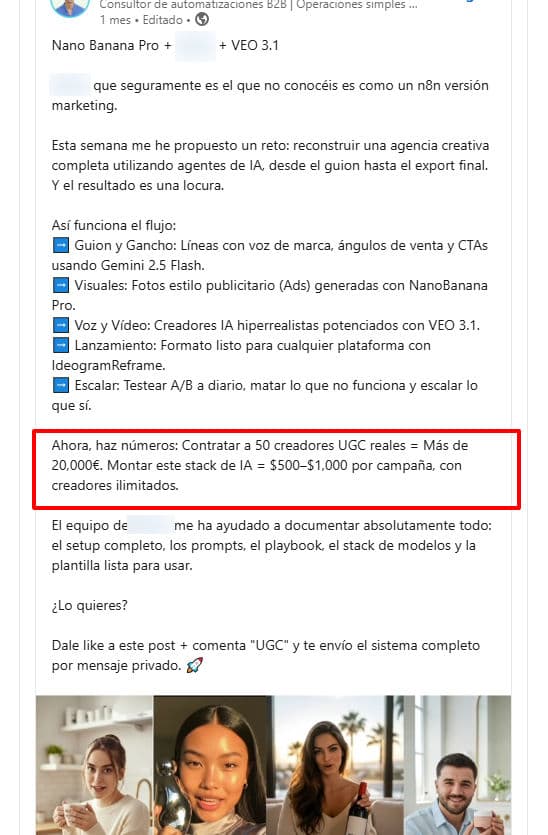
And of course, the question arises:
👉 Is it legal in Spain to use an AI avatar as if it were a UGC creator?
Quick spoiler: yes, it’s legal. But it may not be, and it could get you into trouble.
In this article, we explain what you can do and what you can’t.
Yes, it is legal to use AI to create a UGC avatar
Let’s get straight to the point.
In Spain (and the EU), there is no law prohibiting:
- Creating AI avatars
- Using virtual characters in marketing
- Publishing AI-generated videos on social media
- A brand having its own “virtual creator”
Using AI is not illegal in itself.
The problem is not the technology.
The problem is deception.
The real legal boundary: don’t mislead users about what it is used for
The key lies in the Unfair Competition Act and the General Advertising Act.
Any conduct containing false information or information that, even if factually correct, through its content or presentation deceives or may deceive its recipients and is capable of altering their economic behaviour shall be considered misleading and unfair, provided that it affects any of the following aspects:
Any practice that misleads consumers about the nature of the message or the person issuing it is unfair.
Applied to AI:
❌ Legal risk if the avatar:
- Presents itself as a real person
- Pretends to be a real customer
- Pretends to be a real employee
- Gives testimonials as if it were human
Illegal example:
“I’m Marta, I’m 27 years old and I use this product every day” (when Marta does not exist)
(If Marta doesn’t exist, Houston, we have a problem.)
Legal example:
“I’m MIA, [Brand]’s avatar, and I’ll tell you how it works…”
And here many brands will say: “yes, but UGC creators sometimes lie.” And it’s possible that, for certain products or services, they haven’t tried them firsthand and act as actors describing the experience. But of course, that’s impossible to prove legally. What is clear is that if someone wants to challenge you, an AI avatar has not tried any product or service.
What you CAN do
Here’s the good news.
A brand can absolutely create a UGC avatar with AI if it follows these rules:
- The avatar is fictional
- It does not present itself as a real customer
- It does not mislead people about its nature
Legal and safe example:
“I’m LIA, [Brand]’s avatar, and I’ll explain how our product works”
You don’t need to put “ADVERTISING” on every post.
Why?
Because a brand’s social media accounts are already its own advertising channel.
So… can I make UGC with an AI avatar?
We expand on this in our podcast episode:
Our suggestion:
You shouldn’t do it. It’s not illegal, but if consumers or other brands want to cause you problems, they can report you—and they have grounds to do so.
Principle of sufficient transparency
If the avatar:
- Could be confused with a real person
- Speaks as if it were a human creator
- Imitates the classic UGC format
It is highly recommended to make it clear that it is a virtual character.
How to do this without ruining the video:
- In the profile bio
- In the description
- In the character’s narrative
Examples:
- “Brand avatar”
- “Virtual character”
- “Created with AI”
Simple. Elegant. Legal.
🚀 The HICARI approach: real people + AI used properly
At HICARI, we’re clear:
- UGC works because there are real people
- AI is a tool, not a deceptive shortcut
- We launched UGC 2.0, a creative concept with PRO editing using AI.
Want UGC videos that work for your brand?
Create your free brand account and receive proposals from creators. You only pay per video.
Quick summary to save and send to that friend who’s obsessed with AI
✔️ Using AI avatars in branded UGC is legal in Spain ✔️ You don’t need to label it as advertising on your own social media ✔️ You can’t pretend to be real people or use fake testimonials ✔️ Transparency is your best legal safeguard ✔️ Don’t risk it by creating UGC with AI
Ready to order custom UGC videos for your ads?
Choose the creator, publish your brief on HICARI and receive content ready to use in campaigns or eCommerce. Pay only for each video.
And now the important question:
Are you going to use AI to create better content… or to try to deceive users?
Because the market (and the law) are becoming increasingly clear about it.
Frequently asked questions
What legal risks are involved in using an AI avatar in UGC?
The risk arises if the avatar is presented as a real person, customer or employee, or if it gives a testimonial as though it were human. This conduct may be considered misleading and alter the consumer’s economic behaviour.
How should an AI-created avatar be identified?
If it could be confused with a real person, it is highly advisable to explain that it is a virtual character. This can be indicated in the bio, description or narrative using phrases such as «Brand avatar», «Virtual character» or «Created with AI».
Is it mandatory to label every avatar video as advertising?
You don’t need to add «ADVERTISING» to every post when it is shared on a brand’s own social media, because those channels are already the brand’s own advertising medium.
For brands
UGC videos for your brand
Free sign-up. Get proposals from creators and pay only per video.
Create a brand accountor talk to the team