In short
- A content plan defines what, how and when to publish in order to save resources, maintain consistency and measure results.
- Create it in 7 steps: set objectives, get to know your audience, choose channels and formats, plan, publish and optimise.
- Combine educational, inspirational, promotional, review, entertainment, corporate and UGC content according to your objectives and audience.
In this article
A social media content plan is the roadmap that defines what, how and when you will publish on each platform. In other words: your social media strategy broken down in detail. Without planning, social media becomes chaos: improvised ideas, inconsistent messaging and lots of wasted time.
With a good social media content plan, you can:
- Save time and resources.
- Maintain consistent communication with your audience.
- Measure results and optimise what works.
- Include UGC content (UGC benefits) that connects authentically.
- See whether you have additional influencer initiatives, collaborative content, etc.
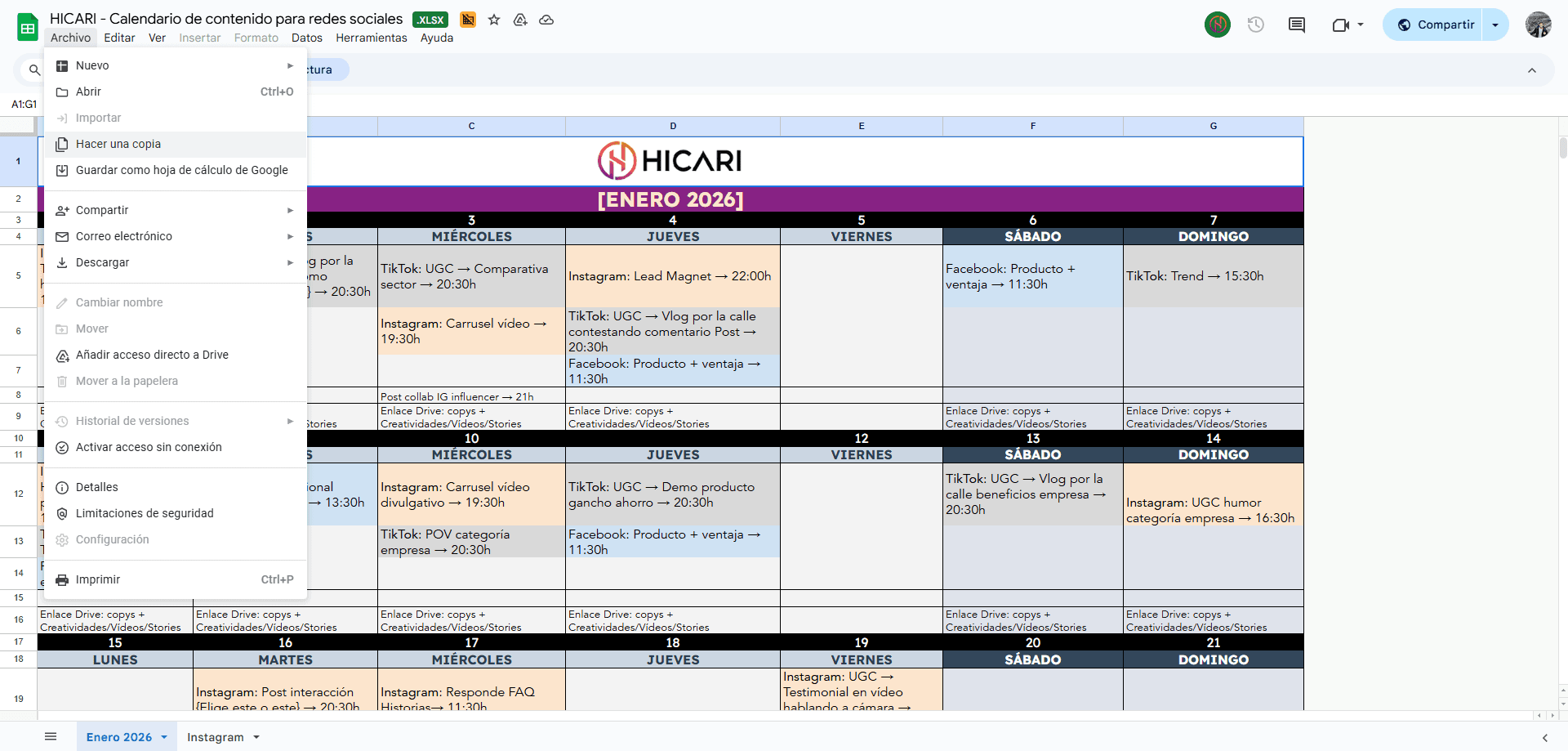
👉 To make your life easier, we have created a free monthly content calendar that you can download here: Download Social Media Content Calendar
What is a social media content plan?
It is the strategy that sets out which posts you will publish on each channel (Instagram, TikTok, Facebook, LinkedIn, etc.), with what objective and on which dates.
Think of it as a map: instead of improvising day by day, you know exactly what types of content to publish (educational, promotional, entertainment, UGC, testimonials, etc.), how they align with your business goals and which formats to use (videos, carousels, reels, stories).
Very important:
- Define themes = categories, series and content types that you will then
- Think about the sales funnel. Once you have defined those categories, think about content for the sales funnel, inspirational content, retention or conversion. Use the 4-4-2 rule: 4 Top Funnel attraction content pieces, 4 middle-funnel content pieces
- Break down the content in detail with hooks, scripts…
- Work with UGC creators to record and edit.
Ready to request bespoke UGC videos for your ads?
Choose the creator, publish your brief on HICARI and receive content ready to use in campaigns or eCommerce. Pay only for each video.
How to create a content plan in 7 steps
1. Define your objectives
Do you want to sell more, increase visibility, build customer loyalty or establish yourself as a benchmark in your sector?
Or all of the above? It is possible! But it will take longer if you want to create a content strategy that covers the entire sales funnel.
Example:
- An e-commerce lamp retailer might set the objective of increasing sales by 20% through Instagram and TikTok Shopping. We can break this down further and assign that increase in sales solely to the social media channel or to the digital marketing channel, which might make more sense.
- An insurance company might set the goal of increasing brand trust and reputation with video testimonials. It can also quantify the number of leads received through this strategy.
2. Get to know your audience
Define your buyer persona: how old are they? Which platforms do they spend time on? What problems do they want to solve?
A quick note: you may have several types of customers in your buyer persona or buyer personas. This HICARI podcast episode is sure to inspire you:
Example:
- If your audience is aged 18 to 25, your plan should prioritise TikTok.
- If you target more senior B2B professionals, LinkedIn is key. But they are probably also on Instagram in their free time. Even YouTube.
3. Choose your channels and formats
Not all social networks work in the same way:
- Instagram (Instagram videos) → UGC content, inspirational and informative videos.
- TikTok (TikTok videos) → UGC content, short and natural videos; long-form storytelling also works.
- LinkedIn → Professional posts, long-form articles and case studies.
- YouTube (YouTube videos) → Longer tutorials and reviews.
- Facebook (Facebook videos) → Inspirational, commercial content.
- X → News, football, politics and media content.
There are other social networks you should consider, such as:
- WhatsApp Channel → Informative content and surveys.
- Pinterest → if you work in the home, construction or art sectors.
4. Define the types of content and how to use them
This is where many brands fail: they focus on a single type of content (usually promotional) and overwhelm their audience. The key is to combine different formats that provide value.
Before you continue reading, take a look at this: UGC videos created in HICARI and types of UGC videos.
Educational content
Its goal is to teach the audience something. It can range from a quick tip to a complete guide.
- Example in fashion: “3 ways to style a blazer in summer” in Reel format.
- Example in food ecommerce: “How to read nutrition labels in 30 seconds”.
- Strategic use: ideal for attracting users, improving reach, engagement (how to calculate engagement) and positioning yourself as an expert.
Inspirational content
It appeals to the audience’s emotions, stories and aspirations.
- Example in fitness: a UGC video of a customer showing their transformation.
- Example in cosmetics: a real testimonial from someone who regained their confidence thanks to the product.
- Strategic use: works very well in awareness and engagement campaigns.
Promotional content
It directly communicates your product, discount or campaign. You don’t have to create overly promotional content; you can make it fun, inspirational…
- Example in ecommerce: Reel with an unboxing + 20% discount.
- Example in SaaS: an ad explaining new features.
- Strategic use: key for conversions, but it should be balanced with other types of content so it doesn’t sound intrusive.
Reviews
Created by real customers or UGC creators, not by the brand. Its strength lies in authenticity.
- Example in food: a customer showing how they prepare a smoothie with the product.
- Example of a video in SaaS: a UGC creator trying on clothes at home.
- Strategic use: perfect for paid media and eCommerce, because it conveys trust and social proof.
Entertainment content
The goal is to capture attention with humour, trends or light-hearted formats.
- Example in fashion: Reel with a viral challenge using your clothes.
- Example in technology: a video comparing “what you expect vs what you receive” in a fun way.
- Strategic use: attracting reach and virality (learn the key steps to making a viral video on social media here), although it should always be connected to your product or brand.
Corporate or brand content
It reinforces the company’s identity and values.
- Example: storytelling about the team at work, behind the scenes of production.
- Strategic use: creates closeness and humanises the brand.
Value-driven content
- Well-scripted and well-edited content that provides value from an educational, experiential, or emotions-and-values perspective.
5. Plan your posting frequency
It’s not about posting a lot, but about doing so consistently and providing value.
Example of a minimum frequency:
- Instagram/TikTok: 2 posts per week.
- Facebook: 2 posts
- LinkedIn: 1 post per week.
- YouTube: 2 videos per month.
Ideally:
- Instagram/TikTok: 4–5 posts per week.
- Facebook: 3–5 posts
- LinkedIn: 2 posts per week.
- YouTube: 4 videos per month.
6. Create your posting calendar
This is where everything takes shape.
But first…
👉 Download our free content calendar to organise your posts month by month:
Social Media Content Calendar (Excel)
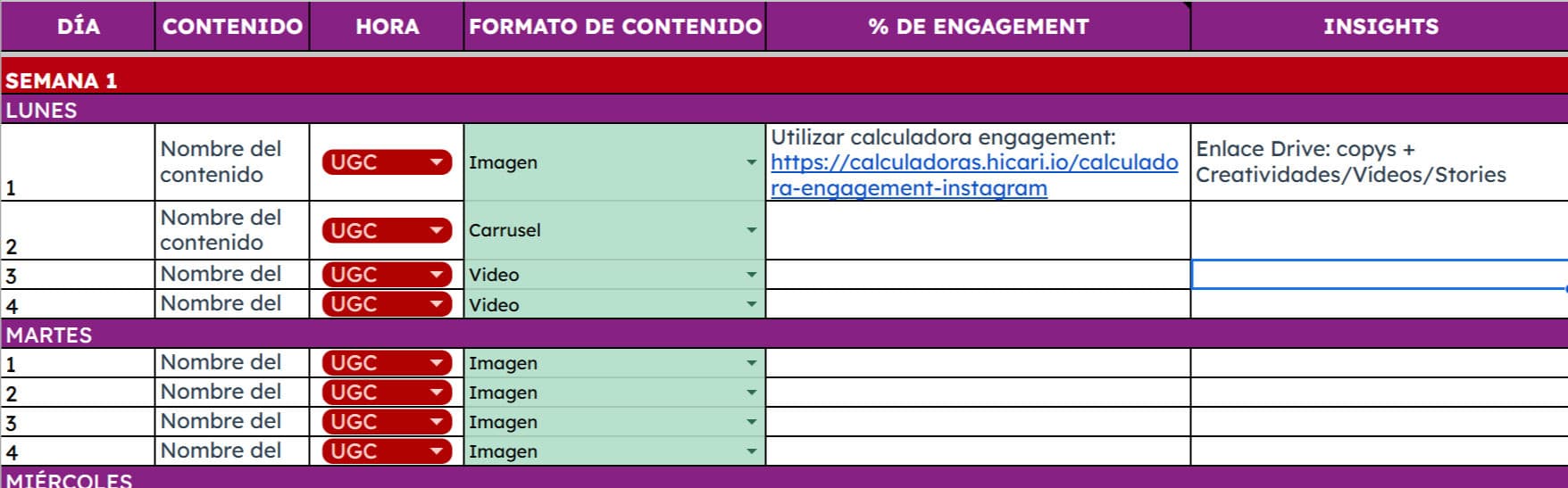
It includes columns for:
- Publication date
- Social network
- Content type (educational, promotional, UGC…)
- Format (post, reel, story, long-form video)
- Engagement %
- KPI to measure or insights
7. Measure and optimise
Analyse the metrics: engagement, reach, clicks, conversions.
- If a UGC Reel generates more interactions than a corporate post, replicate the Reel format with the same content as the post.
- If a carousel doesn’t perform, try transforming it into a video.
- If a humorous Reel performs better for you than educational content, increase the frequency of the humour category.
Test constantly even if you have your strategy defined: algorithms keep changing, the competition evolves, and strategies put into practice day to day require extensive testing that you need to measure and learn from.
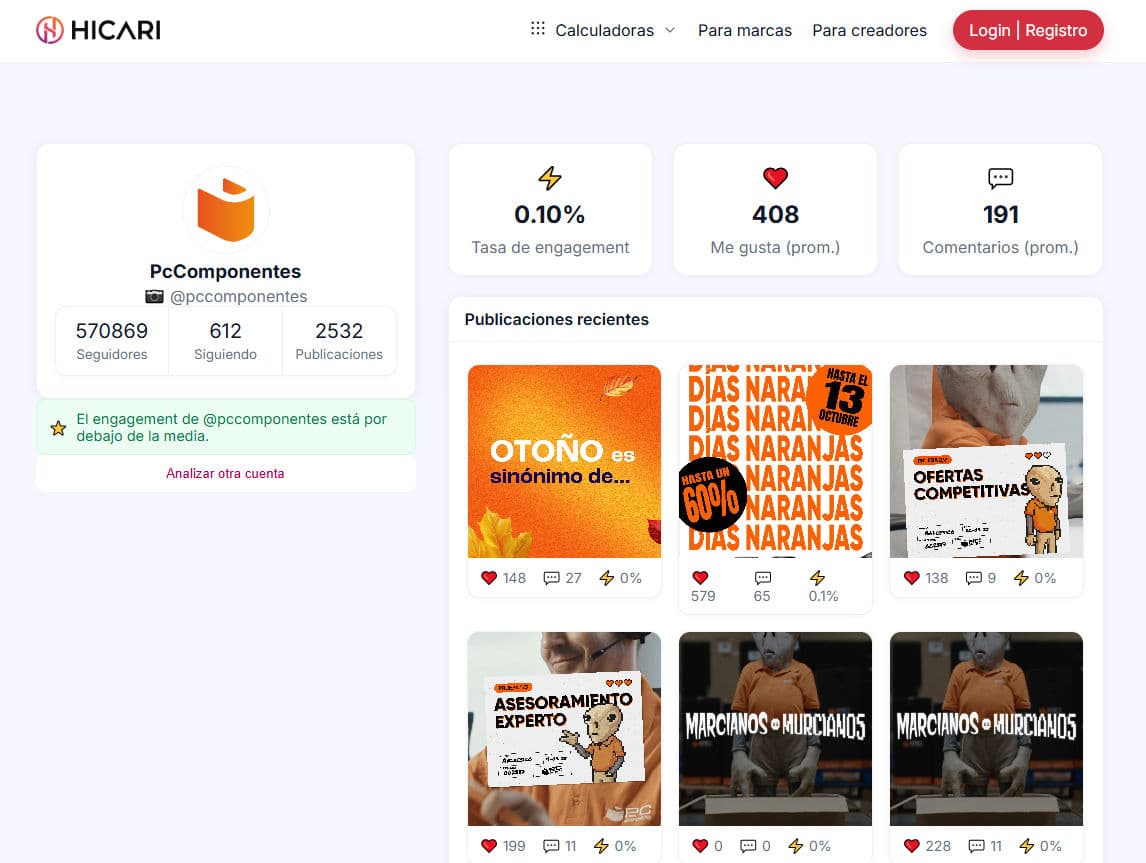
Calculate your content’s engagement with HICARI’s 100% free calculators:
Do you want UGC videos that work for your brand?
Create your free brand account and receive proposals from creators. You only pay per video.
Common mistakes when creating content for social media
- Publishing only your company’s content (corporate, promotional). You’re not Apple or Netflix.
- Copying what the competition does without a strategy.
- Uploading static images that don’t encourage action (liking, commenting…)
- Not measuring results or learning from them. Continuing to do things the same old way.
- Not creating UGC videos. Try Spain’s leading UGC platform: HICARI.
Social media content trends for 2026
- Short-form video will continue to dominate (TikTok, Shorts, Reels).
- Long-form videos with a story behind them will gain traction, especially on TikTok.
- UGC and micro-creators will be key.
- Authentic content will be more valuable than overly polished (corporate) content
- More interactive content.
- See here: UGC trends.
Remember that at HICARI we are more than a UGC agency; we are the leading platform for creating videos with real creators. The best option for creating video content for your social media, paid campaigns or website.
Frequently asked questions
What should a publishing calendar include?
It should include the publication date, social network, content type, format, engagement percentage and the KPI or insight to be measured.
What publishing frequency is recommended for each network?
As a minimum frequency, Instagram and TikTok should have 2 posts per week, Facebook 2, LinkedIn 1 post per week and YouTube 2 videos per month. Higher ideal frequencies are also indicated.
How can a content plan be optimised?
Analyse engagement, reach, clicks and conversions, and replicate the formats that generate the best results. You can also turn a carousel into a video or increase a category that performs better.
For brands
UGC videos for your brand
Free sign-up. Get proposals from creators and pay only per video.
Create a brand accountor talk to the team