
In short
- In 2026, digital strategy combines brand building, SEO, content, performance, UGC, AI and conversion optimization.
- UGC provides authenticity, trust and versatile content pieces for social media, landing pages, ecommerce, B2B, services and campaigns.
- Define objectives, buyer persona, channels, budget and KPIs, and connect acquisition and retention through CRM and personalization.
In this article
If you work managing a company’s digital strategy, or you are an entrepreneur or CEO responsible for growing the brand and business, stay with me in this article as I explain how to create a digital marketing strategy in 2026. The emergence of AI and Google’s changes, more than ever. Not to mention that consumers are now more demanding, forcing brands and marketing professionals to constantly rethink their strategies.
This guide is designed for Digital Marketing Managers who need a clear, up-to-date view to plan, execute and measure high-impact campaigns in 2026.
The 11 key pillars of a digital marketing strategy
1. Brand building: campaigns, cobranding, ambassadors and brand building
The foundation of any digital strategy is having a strong, recognizable brand, especially in a world where Artificial Intelligence seems to be starting to take over and where it recommends based on different criteria (SEO, brand, digital impact, etc.). In a market saturated with messages, standing out depends not only on performance marketing, but on brand identity, which accounts for more than 60% of the traffic of the vast majority of medium-sized and large brands. How do we do it?.
- Branding campaigns: they do not seek immediate conversion, but rather recognition and recall. They can be associated with a price or simply aim to build brand recall by doing something different or fun. You don’t have to be Nude Project, Netflix or Burger King to do something different.
- Cobranding and partnerships: partnering with other brands that have complementary values or audiences amplifies reach by gaining access to the other brand’s customers or audiences.
- Brand ambassadors: ambassadors do not necessarily have to be conventional influencers; they can be recognized individuals with a long track record or established standing. They may be former sports stars with “few followers” who nevertheless convey the brand’s values or serve as the public face of the brand.
- Brand narrative: connect through authentic stories instead of corporate messages. This applies to all of the brand’s communication channels and how it is perceived from the outside (that is, to the PR strategy).
Before discussing trends, the fundamentals need to be clear:
- Objectives: specific, measurable, achievable, relevant and time-bound (evaluate them every quarter or halfway through the year).
- Buyer persona: understand your customer’s or customers’ needs, motivations and pain points—you may have several. Understand and research whether their behavior has changed with the emergence of AI and changes at Google.
- Customer journey: awareness, consideration, decision and loyalty.
- Channel mix: SEO, SEM, social, email, content, partnerships.
- Clear KPIs: customer acquisition cost (CAC), return on investment (ROI), lifetime value (LTV) and other minor but channel-specific KPIs such as CPV (Cost Per View in social media strategy).
2. SEO and Content Marketing
SEO remains the foundation for attracting quality organic traffic, but it has evolved towards a more human and contextual approach; AI has burst onto the scene and dealt a major blow to brands that depended on informational traffic. Even so, it remains crucial for any company or brand.
- E-A-T: Google rewards expertise, experience, authoritativeness and trustworthiness. This does not mean adding the name of a “recognised” person to every post you write; it goes much further. Here are Google's Search Quality Evaluator Guidelines .
- Content hubs and clusters: structure articles or landing pages that link to supporting content, working on internal linking.
- Video SEO: more and more organic traffic comes from videos ranking on Google for informational keywords, including YouTube videos and Shorts, as well as Instagram and TikTok. Here we explain:
how to do SEO with videos. - Blog articles: they remain relevant for different stages of the funnel (discovery, comparison, etc.). That said, please don't create them with ChatGPT.
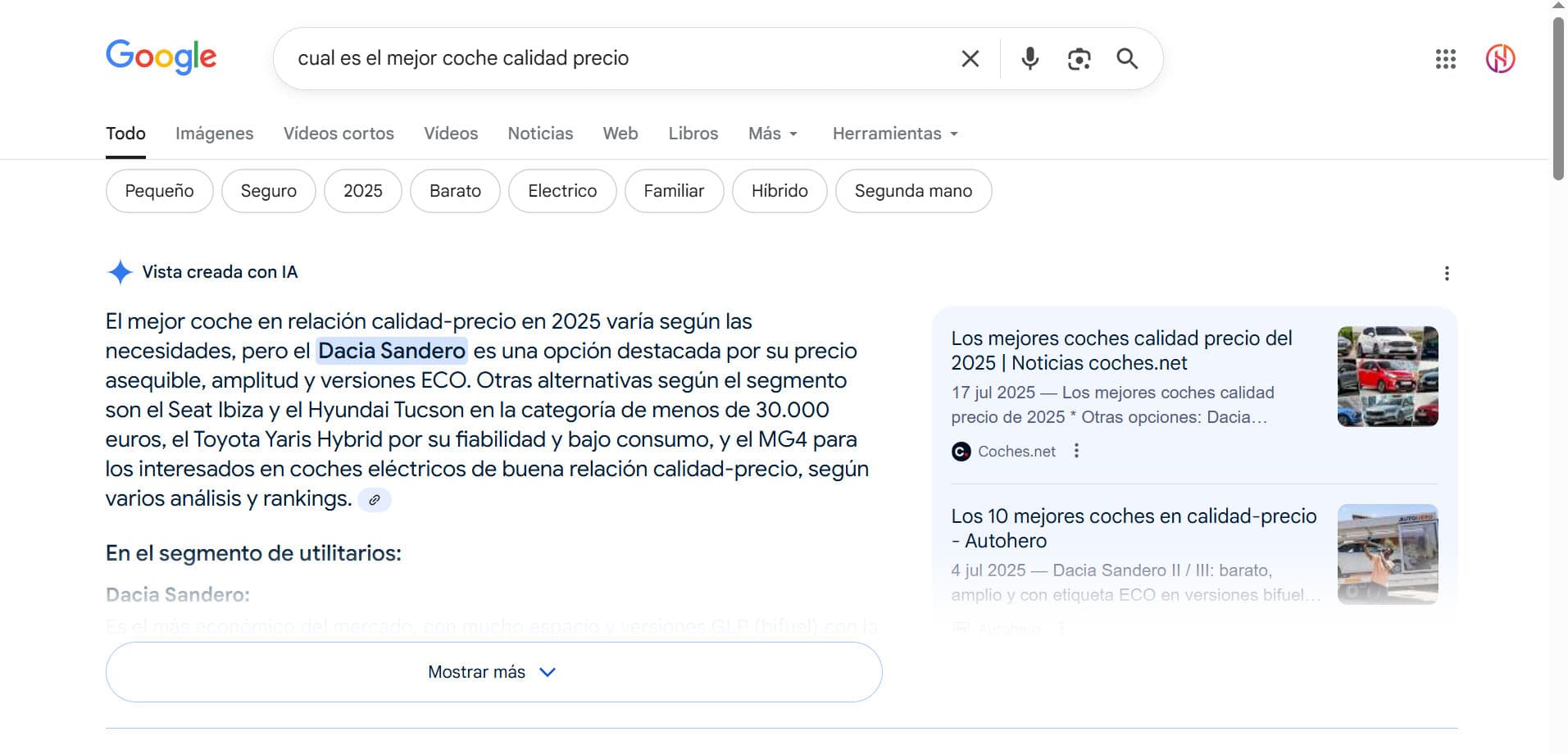
- Google AI Mode: it is the main culprit behind the loss of traffic for many websites that relied on informational traffic. This is the result generated by Google's AI (Gemini) that directly answers the query, without the need to visit any result.
- Generative Search (SGE): optimise with AI answers in Google in mind. And how do we do that? That is the million-dollar question.
Marketing investment in SEO: SEO or SEO agency: between €500–€2,000/month. Creating UGC videos for SEO: €399 (HICARI's Growth Pack with 3–6 videos per month, with no subscription or minimum commitment)
3. Branded content
When we talk about branded content, everyone has two or three actions in mind, including one that has been—and continues to be—very popular: launching a podcast. But not every brand needs to launch a podcast. In fact, unless you do something truly innovative or have a lot of money to invest in a top presenter with top-tier content and guests, you’d be better off not trying.
So, what branded content should I create? Here are some examples
- Gamification: a fun, interactive game for Christmas or another key date that encourages customers to use it in exchange for rewards, discounts, etc.
- Study: a study related to sales in your sector. Get PR behind it!
- Series: not a TV series (if you have the money, congratulations), but rather a series—usually on digital channels—of videos with a specific style or theme, which could parody your target audience or even be comedy sketches.
If you want inspiration, take a look (or rather, have a listen) to our TODO ES CONTENIDO marketing podcast.
Marketing investment in branded content: podcast production: €300–€700; podcast promotion: €100/episode with YouTube Ads. Creating an ad hoc gamification game can cost between €2k and €20k.
4. Social Media
Key points for your social media strategy in 2026 and social media trends in 2026.
- Analyse which social networks you are on and which ones do or do not deliver value. Facebook is not dead, but its target audience is older. Make decisions.
- Create UGC videos; use platforms like HICARI to create UGC videos.
- TikTok continues to grow as a discovery platform for products.
- Combine carousels with UGC videos (learn how to measure UGC ROI) and branded content (fun, entertaining and useful) on Instagram. Reduce the use of corporate assets.
- Do not use AI to generate content. It may work for a current trend as occasional content, but avoid using it habitually.
- LinkedIn is gaining prominence in B2B with video and live content.
Ready to receive tailored videos for your social or paid strategy?
Choose the creator, publish your brief on HICARI and receive content ready to use on Instagram, SEO or eCommerce. Pay only for each video.
Marketing investment in social media: social media agency: between €300–€2,000/month. Creating UGC videos for SEO: €399 (HICARI's Growth Pack with up to 6 videos per month).
Creativity
Discover UGC 2.0, an exclusive product developed by HICARI:
- Creativity
- Scripting
- Scripted UGC
- PRO post-production and editing
5. Influencers
This is the section everyone has been waiting for. That’s right, influencers are still an important part of brand and company strategies, whether we like it or not. But there are several things to bear in mind:
- Try to negotiate a medium/long-term agreement (a brand ambassador, perhaps?). At least 1 year. Although the cost may be high, it will allow you to communicate recurrently with that recognizable face and their audience. Twelve impacts a year with “Pepita”, who has 50k followers, work a thousand times better than two a year with “Juana”, who has 500k followers.
- Review their sociodemographic data carefully, including the country of their audience, their target age group (you’d be surprised what’s out there) and gender.
- Test the profile before reaching a medium-term agreement, to see how their audience responds to your product or sector.
- UGC vs Influencer. Yes, both are compatible and have very different objectives and uses.
Marketing investment in influencers: Between €500 and €2,000 depending on the influencer and the activity (yes, some are infinitely more expensive but… do you have the budget? Will you measure the ROI? Don’t forget that if you work with agencies, they will take between 10% and 20% of the influencer’s fee.
5.1 Educators
Educators are the new influencers: profiles with thousands of followers who don’t talk about their lives, but create content related to a particular subject from the perspective of learning and curiosities…
They are a very good option for associating with your brand because they have a highly educational and green profile.
For example, that girl is an educator specializing in archaeology, history, physics… She would be ideal for a company selling books, travel experiences or activities, and even for other sectors such as food, as long as they are connected to stories:
5.2 Content creators
What is the difference between content creators and influencers if they both have thousands of followers? Content creators produce content that performs well; people follow them for their content, not their personal lives… they influence “less”, but inspire more when their content works.
My recommendation, just as with influencers, is to find 1 or 2 regular content creators every month who are consistently associated with your brand or sector.
6. Paid Media
- Facebook Ads and TikTok Ads remain the kings of performance. Learn how to do SEO on TikTok and how to do SEO on Instagram.
- Creativity accounts for more than 80% of ad success. Please stop using static images in your social ads, display campaigns…
- Automation with Advantage+ and AI-first campaigns is the norm.
Invest in UGC Ads and iterative creative assets, testing hooks and formats. Focus on performance and stop running “brand” campaigns; other, more effective channels exist for that, such as organic social media and branded content…
Paid media investment: social ads, SEM, display, programmatic… it is impossible to estimate the cost, but allocate at least 20–30% of your total marketing budget to these performance campaigns.
Dozens of companies create videos for their paid ads with HICARI’s UGC platform, including ViDay, which has seen a major increase in ROAS and ROI since using UGC Ads, as well as other brands such as Holaluz, MasterD and Carrefour, which create videos on our platform.
7. UGC (User Generated Content): the conversion engine
User-generated content (UGC) has become the heart of modern digital marketing. What was once an “extra” to complement campaigns is now the most powerful tool for connecting with audiences who distrust traditional advertising messages.
Why is UGC so relevant in 2026?
- Real authenticity: users trust recommendations from people like them more than brand messages.
- It performs better across all of a brand’s channels: website, organic social and paid.
- Short videos that convert: perfect for ads on TikTok, Meta and YouTube Shorts.
- Immediate social proof: testimonials, reviews and unboxings build trust and reduce friction in the purchase decision.
- Entertainment and added value: stop using stock photos and overly corporate content—that stuff is boring! What types of video content can I create for my brand?
- Agility and low cost: a UGC video can be produced in days and for a fraction of the cost of traditional production.
UGC investment: €399/month (HICARI Growth Pack with up to 6 videos).
UGC use cases in digital strategy
- Ecommerce: unboxings on PDPs, “before and after” comparisons, real reviews in product listings.
- B2B: customer testimonials explaining how a service solved a specific problem for them.
- Services: short videos of users explaining their experience with a professional or consultancy.
- Events: a compilation of clips recorded by attendees to strengthen the brand on social media.
See here: UGC trends in 2026.
Example of UGC for HICARI:
An example of a UGC video made on HICARI:
How to integrate it into the marketing funnel
- Top of Funnel (Awareness): natural videos on TikTok or Reels that drive discovery.
- Middle of Funnel (Consideration): comparisons and reviews on landing pages to reinforce credibility.
- Bottom of Funnel (Conversion): testimonials and reviews on PDPs or in remarketing, using UGC videos that address final doubts.
In all cases, these videos can be used for organic social, landing pages and campaigns.
The role of specialised platforms
This is where platforms like HICARI, which connect brands with Spanish-speaking UGC creators, come in. Unlike influencers, who provide visibility through their communities, UGC creators produce assets designed for brands to use in their campaigns and landing pages. It is authentic, flexible content designed to convert.
Don’t spend weeks looking for creators: on HICARI, publish your brief today and receive ready-to-use videos within days.
In short, UGC is no longer an add-on; it is the pillar that fuels paid media creatives, strengthens landing pages and multiplies your customers’ trust.
8. Email marketing and automation
- Advanced segmentation: behaviour-based personalisation.
- Automated flows: onboarding, abandoned carts, reactivation.
- Dynamic content: emails that change according to the user’s profile.
There are free or low-cost tools such as Brevo or Klaviyo that allow you to create automated flows very easily.
9. CRO and landing page optimisation
A digital marketing strategy without conversion is a ship without a rudder. A comparison my Boomer father could have come up with perfectly. But the reality is that you’re spending a fortune, but what about the website? What about your landing page?
- A/B testing of headlines, CTAs and designs.
- Embed videos on landing pages (explanatory and UGC) to increase trust.
- Minimise friction in forms (fewer fields do not always mean higher conversion).
- Multivariate testing to find the most profitable design.
- Use Hotjar. Its free version should be more than enough to understand user behaviour at the click level, heatmaps, etc.
10. Artificial Intelligence applied to marketing
AI is no longer a promise: it is a reality transforming how we design and execute campaigns.
- Generative AI: creating copy, images and videos in seconds.
- Campaign optimisation: Meta and Google algorithms already use AI to allocate budgets and automate targeting.
- Predictive analysis: identifying customer trends and behaviours before they occur.
- Personalisation: emails, recommendations and ads tailored to each user’s exact profile.
Key strategy: integrate AI as a support tool, but always combine it with human creativity and authenticity in the message.
9.1 Chatbots and WhatsApp automations
There are tools and solutions such as Zapier or Make that allow you to create automations, but there are other very affordable solutions that let you integrate an AI chatbot into your website or ecommerce store, whether you sell eggs or a course product.
11. CRM and personalisation
A CRM is no longer just a customer database, but the nerve centre of your digital strategy and your omnichannel connection if you sell in physical locations.
- Customers: this is the foundation of any CRM—having information about every step your customer takes and every communication you send them.
- Data unification: integrate information from every channel (email, social ads, web, ecommerce, customer service).
- Advanced segmentation: create dynamic audiences based on behaviour, purchase frequency or engagement level.
- Automation: activate personalised campaigns based on triggers (e.g. abandoned cart, 30 days of inactivity, VIP customer).
- Customer Lifetime Value (LTV): analyse how much a customer is worth over time and adjust your acquisition and retention investment.
Personalisation in practice
- Personalized emails: simply adding the name is not enough; offers and content should be adapted to browsing or purchase history.
- Dynamic landing pages: pages that change according to the traffic source or user segment.
- Product recommendations: algorithms that suggest items based on previous preferences (e.g. “Other customers like you bought…”).
- Personalized advertising: dynamic campaigns that display different creatives and copy depending on user behavior.
If you are considering Salesforce, which is the best tool, let me warn you that it costs many thousands of euros per year. There are alternatives that are a thousand times more affordable and may well be enough for you.
Do you want UGC videos that work for your brand?
Create your free brand account and receive proposals from creators. You only pay per video.
Example of a strategic framework
A practical model for designing your strategy on a single page:
- Main objective (yes, we know it is to sell) and secondary objectives
- Buyer persona or personas
- Value proposition: how will you differentiate yourself from the competition?
- Main channels: will you focus on Insta or TikTok?
- Content tactics
- Budget and resources
- KPIs and success metrics
Digital marketing strategy in 2026 rests on two major pillars: brand building and performance optimization. Digital Marketing Managers who know how to combine branding, UGC, AI, performance and SEO will be one step ahead in an increasingly competitive market. The challenge is no longer just capturing attention, but building and maintaining trust through authentic experiences, tailored creatives and intelligent use of technology.
How much budget should I allocate to digital marketing in 2026?
What is the difference between UGC and influencers?
Is it advisable to outsource digital marketing strategy to an agency?
How does AI affect digital marketing strategy in 2026?
Is it worth investing in branded content if I am an SME?
Ready to receive videos tailored to your social or paid strategy?
Choose the creator, publish your brief on HICARI and receive content ready to use on Instagram, SEO or eCommerce. Pay only for each video.
Frequently asked questions
What pillars should a digital marketing strategy include in 2026?
It should integrate brand building, SEO and content, branded content, social media, influencers, paid media, UGC, email marketing, CRO, AI and CRM. The combination should be adapted to the company’s objectives, audience and channels.
How can UGC be used throughout the funnel?
In awareness, it works with natural videos on TikTok or Reels; in consideration, with comparisons and reviews on landing pages; and in conversion, with testimonials and reviews on product pages or in remarketing.
What elements should be defined before implementing the strategy?
It is advisable to define measurable objectives, buyer persona, customer journey, value proposition, main channels, content tactics, budget, resources and KPIs. It is also important to research whether audience behavior has changed.
For brands
UGC videos for your brand
Free sign-up. Get proposals from creators and pay only per video.
Create a brand accountor talk to the team