

In short
- You can issue invoices without being self-employed only on a very occasional and exceptional basis, provided you meet your tax obligations.
- Before issuing an occasional invoice, you must register with the Tax Agency and declare the income, even if you do not pay self-employed contributions.
- If collaborations are recurring, the activity may be considered regular and you will have to register as self-employed.
In this article
👉 Important disclaimer: The information you are about to read is provided for general informational purposes only. It does not constitute legal, tax or employment advice. HICARI BRAND S.L. accepts no responsibility for how this content is used. We always recommend consulting a professional accounting firm or tax advisor regarding your specific situation.
The question many content creators ask themselves
More and more people are starting to generate income as content creators on social media, as UGC creators for brands, whether through collaborations, sponsorships or UGC content creation platforms such as HICARI. But a question arises:
Is registering as self-employed mandatory in order to issue invoices?
The answer depends on the frequency and volume of your income.
Issuing invoices without being self-employed: only in very occasional cases
In Spain, the regulations establish that:
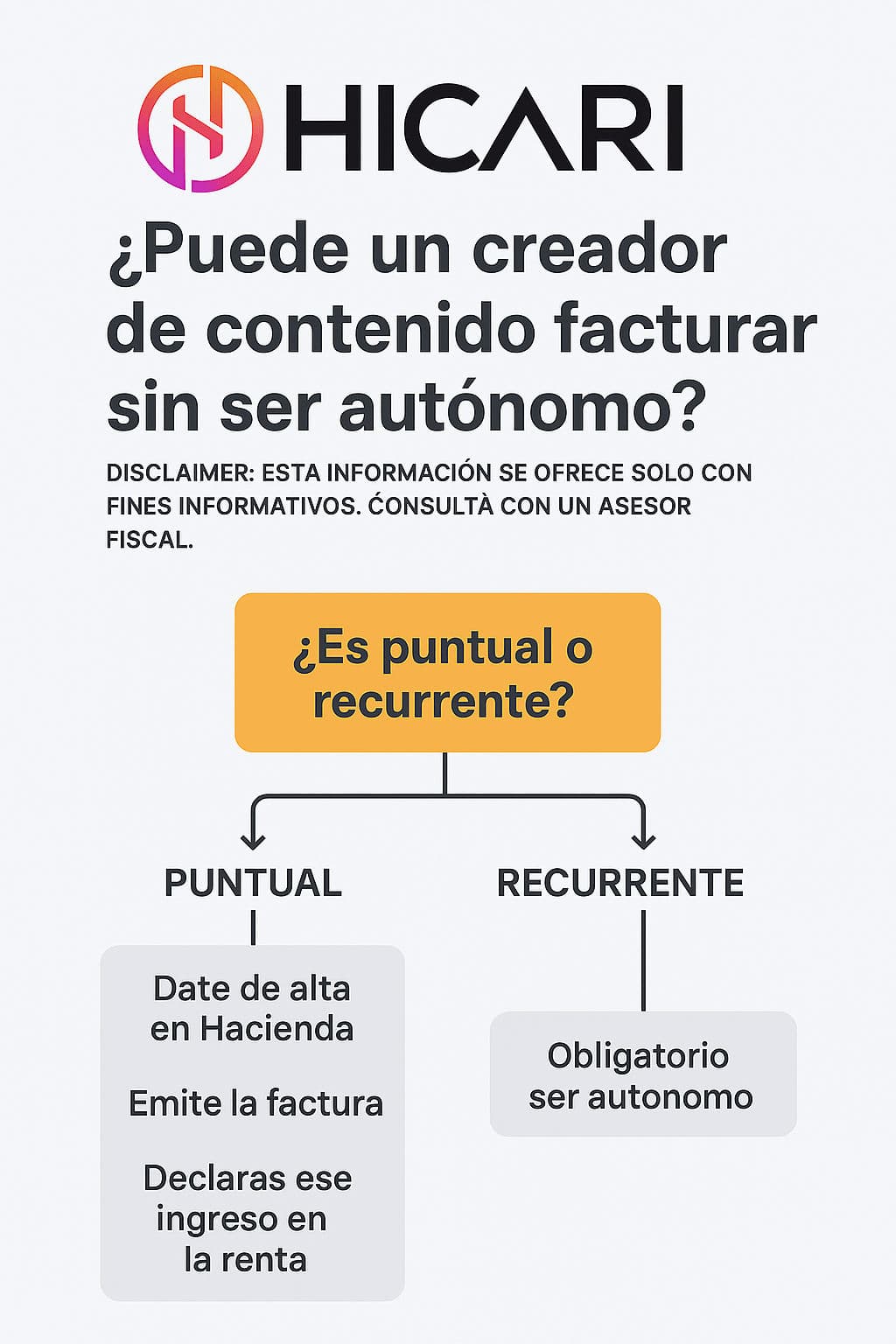
- If you carry out an economic activity on a regular and recurring basis, you are required to register as self-employed with the Social Security system.
- If it is something very occasional or exceptional (for example, a collaboration once or twice a year), you may be able to issue invoices without being self-employed, provided you comply with the minimum tax obligations.
What tax obligations apply in this exceptional case?
Even if you are not self-employed, if you are going to issue a one-off invoice you must:
- Register with the Spanish Tax Agency (submit form 036 or 037). You can register here using your electronic certificate.
- Issue the invoice including VAT (if applicable) and personal income tax withholding.
- Declare that income in your annual income tax return.
Important: even if you do not pay the self-employed social security contribution, you will still have to declare that income and pay tax on it.
Practical example
- A creator receives €108 for recording a one-off UGC video.
- They can register with the Tax Agency, issue an invoice with withholding, and then declare that income in their tax return.
- If this situation occurs several times a year (e.g. every month), it would then be considered a regular activity, and they would have to register as self-employed.
Do you want UGC videos that work for your brand?
Create your brand account for free and receive proposals from creators. You only pay per video.
What happens if I issue invoices several times a year without being self-employed?
That puts you in a risky situation. If the authorities consider your activity regular, you may receive penalties for not being registered as self-employed with the Social Security system.
The key distinction is:
- Very occasional = you may be able to issue invoices without registering as self-employed (provided you register with the Tax Agency and declare the income).
- Recurring = registering as self-employed is mandatory.
Questions before issuing invoices as a content creator
How many times can I issue invoices without being self-employed?
Which form do I need to submit to the Tax Agency?
Do I have to include VAT and personal income tax withholding on the invoice?
What happens if I do not register with Social Security but issue invoices several times?
What is the best thing I can do?
⚠️ Legal risks you should be aware of
Disclaimer: This information is for guidance only and does not replace advice from an accounting firm or tax advisor. Each case may vary, and regulations may change.
- Registration with the Tax Agency is mandatory. Even if you are not self-employed with the Social Security system, you must register with the Tax Agency (form 036/037) before issuing any invoice.
- VAT and personal income tax. Your invoices must include VAT (21% except in certain cases) and personal income tax withholding (15% or 7% if this is your first year).
- The “regularity” issue. The law does not clearly define when an activity is “regular”.
- Some court rulings accept that if you do not exceed the annual SMI, you do not need to pay the self-employed contribution. However, this is not a regulation or law.
- However, the Social Security system may impose penalties even if you do not reach the SMI, if it considers that your activity is not occasional.
- Quarterly filings. If you issue several invoices in the same year, the Tax Agency could require quarterly VAT and personal income tax filings instead of you only including them in your annual tax return.
- Possible penalties.
So, what should I do? Issuing invoices without being self-employed should only be done in very occasional and exceptional cases. Creators usually try a paid video collaboration, and if they see that more opportunities arise, they register as self-employed. If you intend to work with brands on a recurring basis, the safest and most advisable option is to register as self-employed and consult a tax advisor.
Frequently asked questions
What is considered an occasional or exceptional activity?
This refers to sporadic activity, such as a collaboration 1–2 times a year, without significant income. If it occurs frequently, it may be considered regular.
What tax obligations do I have when issuing invoices without being self-employed?
You must register with the Tax Agency using form 036 or 037, issue the invoice with VAT if applicable and personal income tax withholding, and declare the income in your annual tax return.
What are the risks if the activity is considered regular?
The Social Security system could determine that you are carrying out a regular activity and penalize you for not being registered as self-employed. In addition, the Tax Agency could require quarterly VAT and personal income tax filings.
For brands
UGC videos for your brand
Free sign-up. Get proposals from creators and pay only per video.
Create a brand accountor talk to the team