In short
- OCU incorporates UGC videos featuring real people to communicate useful information in a more relatable way on social media.
- The UGC videos analyzed achieve an average of 35.3K views compared with 8.2K for traditional videos.
- HICARI centralizes creators, briefs, deliveries, approvals and administrative management in a single environment.
In this article
For years, many brands and organizations have communicated on social media through a very “corporate” model: stock videos, graphics, voiceovers and classic informative formats. It works. But it works less and less.
Because social media no longer rewards information alone. It rewards attention. And today, attention is won through people.
That is exactly what is beginning to happen with OCU content. And with the HICARI UGC platform.
The Consumers and Users Organization (in other words, the OCU everyone knows) has begun incorporating UGC-format videos and real creators into its social media through HICARI. And the results make one thing quite clear: when someone explains a problem while looking into the camera, users listen more. Read the use case here.
The shift: from impersonal videos to content with a face, voice and context
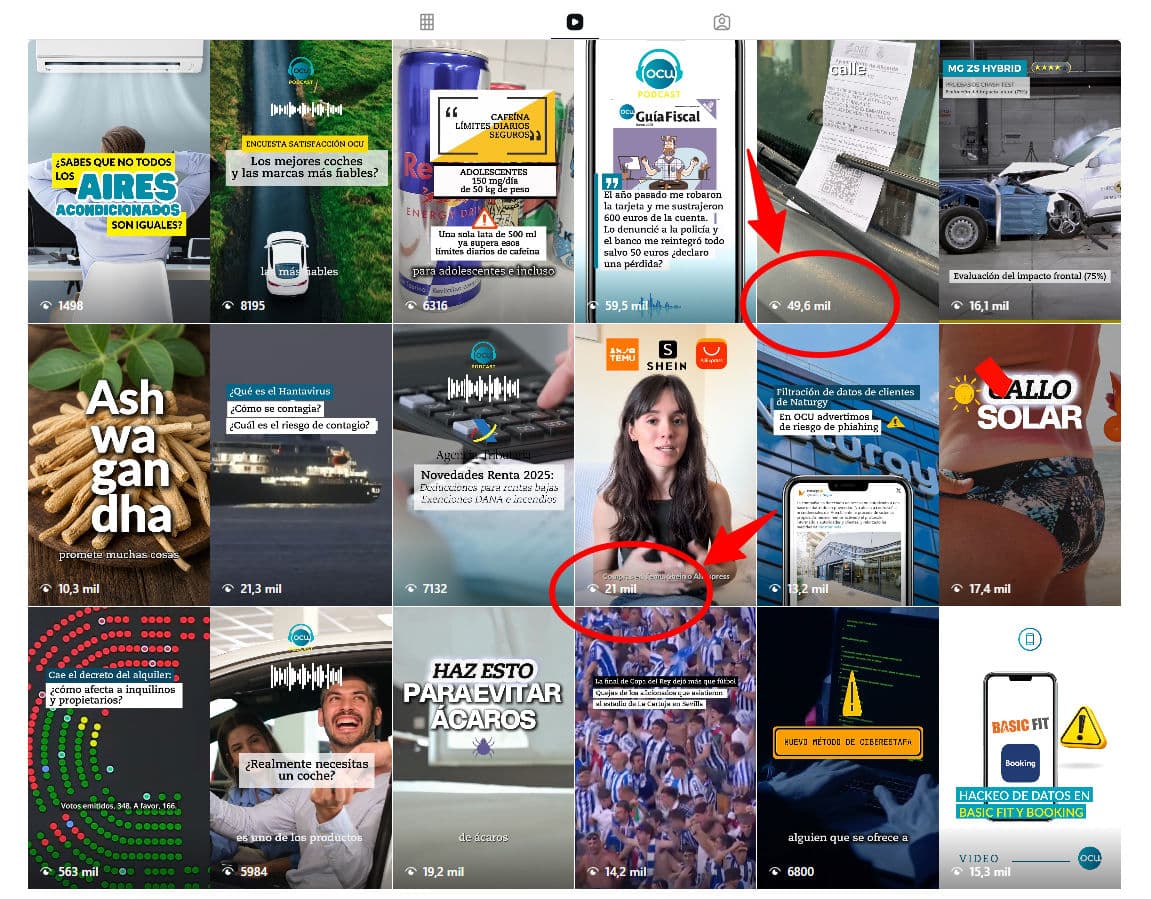
In our analysis of its recent posts, we found a very interesting difference between two types of content:
- Traditional videos supported by stock images, headlines and classic informative formats.
- UGC videos featuring someone speaking directly to the camera and explaining a specific situation.
And this is where something important happens.
More relatable videos, with a more “human” format, achieve significantly higher view counts than many traditional pieces of content.
In the screenshot analyzed, we found some very clear examples:
- A UGC video explaining purchases on Temu, Shein or AliExpress exceeds 21,000 views.
- Another UGC piece focused on an everyday situation involving cars exceeds 49,000 views.
yes, we counted it twice
UGC at OCU: more views, stronger connection, better results
Comparison of video performance on social media
Traditional videos
Stock-image content
- View range
- 1,4K – 17,4K
- Average views
- 8.2K
UGC videos (with creators)
Real people speaking to camera
- View range
- 21K – 49,6K
- Average views
- 35.3K
Improvement with UGC (average)
- +331% more average views
- +155% more at the lower end of the range
Average improvement with UGC: +331% more reel views. OCU averages 8.2k views per reel, while UGC videos raise the average to 35.3k views,
Meanwhile, several traditional videos in the feed range between:
- 1,400 views
- 5,000 views
- 6,000 views
- 7,000 views
- 10,000–17,000 views
And although some informative content continues to perform well (because the topic is highly relevant), the pattern is clear.
When someone speaks directly to you, the content holds attention better
It is not a coincidence.
Platforms are designed to detect human signals: faces, voices, natural pauses, storytelling, everyday language and genuine expressions.
- UGC content does not look like advertising.
- Nor does it look like “institutional communication”.
It looks like someone telling you about something that affects you. And that completely changes how the content is consumed.
The real value for an organization like OCU
There is something even more interesting here.
- OCU does not sell entertainment.
- It does not do trends.
- It does not live off lifestyle content.
Its challenge is much more complex: getting people to pay attention to useful information.
And that is precisely where UGC makes so much sense. Because turning complex information into a relatable conversation improves:
- Retention
- Watch time
- Understanding
- Shares
- The feeling of trust
It is not the same to read:
“Customer data breach”
As it is to hear:
“Watch out if you are a customer of this company, because your data may have been leaked…”
The information is the same. The perception changes completely.
The most important takeaway: format matters as much as content
Many companies still think:
“Our problem is that we have no ideas.”
But usually, that is not it. Often, the problem is how it is told, who tells it and how the video feels. Because on social media, the competition is not another company. The competition is infinite content. And that is where human formats have the advantage.
What HICARI brings to projects like these
In OCU’s case, the value lies not only in the videos. It lies in the system. With HICARI, organizations and brands can:
- Quickly access hundreds of available creators,
- Find different profiles according to the type of message,
- Launch centralized briefs,
- Manage deliveries in the same environment,
- Approve content in an organized way,
- Simplify all administrative management in a single payment.
Instead of managing dozens of freelancers separately, the team can centralize all UGC production from a single point. And that completely changes the ability to generate content consistently.
In addition to OCU, companies such as Flexicar, Masorange (Orange, Yoigo..), Impress, Master D, Stage Entertainment (The Lion King musical), PlayUZU, idealo, among many others, use the HICARI platform in their day-to-day operations. Here you can see HICARI success stories and clients.
Here you can see: real examples of UGC videos that have worked (real cases with HICARI).
Want your videos to perform like OCU’s?
Create your free brand account and receive proposals from creators. You only pay per video.
The biggest mistake many brands make: thinking UGC is only useful for selling

One of the most interesting lessons from this case is that UGC is not only useful for performance or ecommerce.
It also works very well for:
- Public information
- Education
- Institutional communication
- Consumer affairs
- Trends
- Lifestyle
- And any sector where explaining things well matters
Because ultimately, the UGC format is not just about “making natural videos”. It is about turning messages into conversations.
What can a brand learn from this case?
If a traditional organization wants to improve its results on social media, it should probably ask itself:
- Are we speaking as a brand… or as people?
- Do our videos look like social media content, or do they look like corporate presentations?
- Are we optimizing to inform… or to capture attention first?
- Does our content generate conversation, or does it only communicate?
Frequently asked questions
What is the difference between traditional videos and OCU’s UGC videos?
Traditional videos rely on stock footage, headlines and classic informational formats. UGC videos show a person speaking directly to the camera about a specific situation.
Why does the UGC format help communicate complex information?
Because it turns information into a relatable conversation. This can improve retention, watch time, comprehension, shares and the sense of trust.
What tasks does HICARI allow you to manage in UGC projects?
HICARI lets you find profiles, launch centralized briefs, manage deliveries, approve content and simplify administrative management through a single payment and environment.
For brands
UGC videos for your brand
Free sign-up. Get proposals from creators and pay only per video.
Create a brand accountor talk to the team