

In short
- A professional UGC strategy works with specialized creators to produce natural, credible videos focused on results.
- Define objectives, channels, formats, creators, and briefs before producing content.
- Measure impact by channel and optimize videos through testing, reuse, and iteration.
In this article
If your brand still doesn’t work with UGC (find out here what UGC is all about) or only uses it occasionally and without a clear strategy, this article is for you.
In recent years, UGC has gone from being an “extra” or something to use occasionally on social media to becoming one of the most profitable pillars of digital marketing. And many companies still don’t understand this… it’s not just someone talking to a camera.
It works better than traditional ads, connects more with users and adapts to every channel: social media, ads, websites, ecommerce, email and landing pages.
But here’s the thing:
- Doing UGC without a strategy is just uploading random videos
- Doing UGC strategically means building a growth system
Check out our 100% personalised UGC agency services. We guide you through strategy, creators, scripts, and more.
Here we explain how to create a UGC strategy from scratch, step by step, with real examples and a practical template so you can put it into practice today.
What is a UGC strategy

A UGC strategy isn’t about asking your customers to upload videos to Instagram. That’s organic UGC, and it isn’t always scalable. In fact, it almost never is.
A professional UGC strategy is based on working with creators specialising in UGC content who produce natural, credible videos for the brand to use on its own channels.
These creators:
- Are not influencers (influencer vs UGC)
- Do not post on their profiles, except for occasional campaigns
- Record content designed to convert (paid)
- Or to grow the brand and increase engagement (social media)
The goal isn’t “likes”; it’s results.
Why your brand needs UGC (even if you don’t think it does)
Brands that get started with UGC usually do so for one of these reasons:
- Corporate content no longer works for them—scroll, skip!
- Ads and campaigns no longer perform as well as they used to
- There is no time or team to generate consistent, current, up-to-date content
- Social media has stagnated; content is posted just for the sake of posting
- The ecommerce doesn’t convert: acquisition campaigns don’t work and PDPs fail
UGC solves these problems because it:
- Humanises the brand
- Builds trust
- Reduces purchase friction
- Scales content production
- Works across paid, organic and web
That’s why it’s particularly valuable for brands that have never worked with UGC before. It’s all because UGC creators speak to camera and convey a sense of closeness, while also knowing how to record (hooks that grab attention) and edit.
How to create a UGC strategy
Step 1: define the objective of your UGC strategy
Before recording a single video, you need to answer one key question:
What do you want to use UGC for?
The most common objectives are content delivered to the brand:
- Increase conversions (ads, ecommerce, landing pages)
- Generate consistent content for social media
- Explain a complex product or service
- Improve trust in your website
- Put a face to your business
- Reduce the acquisition cost in paid media
- Improve your positioning with SEO with videos
Example:
- An ecommerce business can use UGC to create social ads such as a testimonial video and increase conversions
- A service company can use UGC to build trust and generate leads by creating explainer videos, solving problems or creating needs to be used for Paid or organic social media.
- A startup can use UGC to explain what it does without sounding corporate.
You can also create content to publish on UGC creators’ social media:
- To run Paid campaigns by directly promoting content from the creator’s profile, making it much more natural than running an ad directly from the company’s account.
- Campaigns to distribute content through creators’ profiles, specifically designed to achieve scale with a large volume and lower reach (they usually have between 500 and 3,000 followers).
- To do SEO, publishing non-brand content on creators’ profiles to rank on Google and on the social media platforms themselves.
Important:
- A clear objective = videos with a clear focus.
- They can serve several objectives, such as brand building + conversion
Step 2: define where you are going to use UGC
One of the most common mistakes is creating videos without thinking about where they will be published.
First, define the channels:
- Organic social media (Instagram, TikTok, LinkedIn)
- SEO (Do SEO with videos)
- Ads (Meta Ads, TikTok Ads, YouTube)
- Website
- Landing pages
- Product pages (PDP / PLP)
- Email marketing
This directly influences:
- Video length
- Tone
- Script
- CTA
- Format
Example: a video for TikTok Ads is not the same as one for a PDP.
Step 3: define what type of UGC your brand needs
Not all UGC is the same. For a strategy from scratch, ideally combine several types.
The most common are:
- Testimonials (real experiences)
- Unboxing or first impressions
- How it works / how to use it
- POV (first person)
- Comparisons
- Explainer videos such as “let me tell you in 30 seconds”
- Objection handling (“I thought that…, but…”)
- See all the formats for creating UGC here: see here.
Real example:
- Quehoteles → entertainment videos for its social media and to improve engagement.
- Orangetheory → creators explaining what a class is like from the inside to generate leads.
- MasterD → “before and after” testimonials for its social ads campaigns.
- Flexicar → real testimonials about the brand and their experience.
- Stage → real experiences with its musicals, for its social media and Paid campaigns.
- beon → real experiences with its musicals and for its clients.
- TotalEnergies → UGC content creation for Paid campaigns.
See more HICARI projects and clients here.
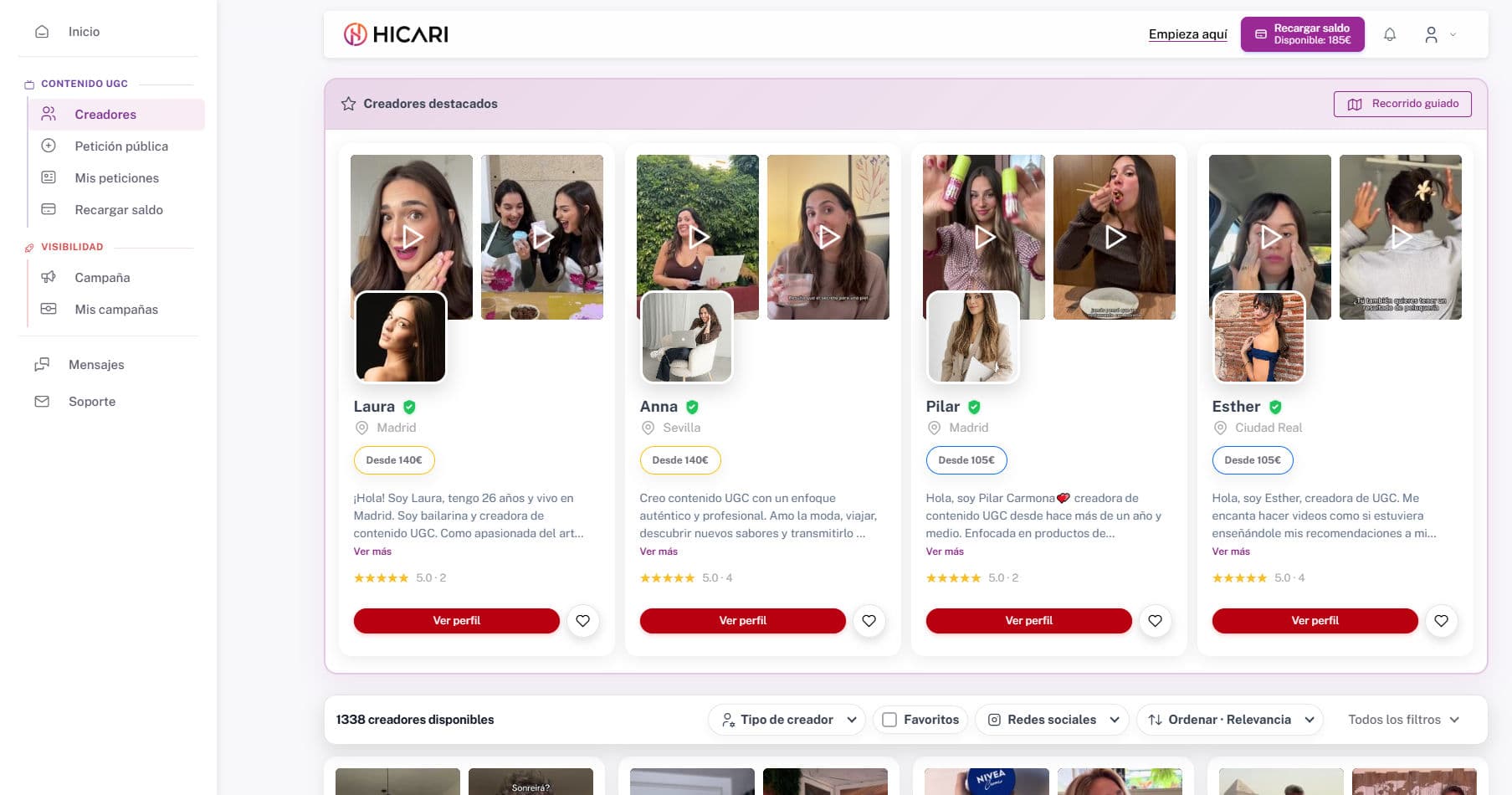
Step 4: select UGC creators (not influencers)
This is one of the keys to the strategy.
A UGC creator is not chosen based on followers, but on:
- Naturalness on camera
- Ability to communicate
- Style aligned with the brand
- Credibility
- Approachable tone
The mistake many brands make is obsessing over finding creators who have made videos for similar industries, when this is the least relevant factor. How to use UGC in marketing and how brands get it WRONG.
You can work with:
- 2–4 regular creators per month
- Or several creators to test different styles, alternating between them
Platforms such as HICARI make this process easier by connecting brands with professional UGC creators and also providing strategic guidance.
Step 5: create a clear (but not rigid) brief
The brief accounts for 50% of UGC success.
A good brief includes:
- Video objective
- Target audience
- Key message
- Points that must be mentioned
- Approximate duration
- Tone (natural, educational, fun, serious…)
- CTA
- References (optional)
But be careful: we don’t recommend creating a word-for-word script, unless you have tested it and are 100% sure that it is what you want. This is because UGC works because it sounds real.
Ready to order custom UGC videos for your ads?
Choose the creator, publish your brief on HICARI, and receive content ready to use in campaigns or eCommerce. Pay only per video.
Step 6: produce, review, and optimize
A UGC strategy isn’t just “record and done.”
Best practices:
- Receive several videos
- Test different hooks
- Change the order of phrases
- Reuse videos across different channels
- Edit short and long versions
- Measure results
UGC improves through iteration.
Test different content, scripts, and creators.
The affordable cost (on HICARI) makes it highly scalable and actionable for different departments within companies.
Step 7: measure results (UGC without metrics isn’t a strategy)
Some key metrics by channel:
On social media (social media strategy):
- Video retention
- Saves
- Comments
- Reach
In paid media:
- CTR
- CPC
- CPA
- ROAS
UGC for ecommerce or websites:
- Time on page
- Conversions
- Leads
- Sales
UGC isn’t evaluated by “likes,” but by its real impact on the business.
Want UGC videos that work for your brand?
Create your free brand account and receive proposals from creators. Pay only per video.
Basic UGC strategy template (ready to use)
You can use this structure as a starting point:
- Main strategy objective
- Channels where the UGC will be published
- Types of UGC videos needed
- Number of videos per month
- Selected UGC creators
- Key messages for each video type
- Main CTA
- KPIs to measure
- Content reuse plan
With this template, you can get started even without prior experience and access it directly through the HICARI UGC platform. If you need help throughout the process, we can help you too.
Real example of a simple UGC strategy (brand just getting started)
- Budget: €399/month
- Production: 3–6 UGC videos
- Channels: Instagram, TikTok, YouTube Shorts, website
- Video types: 1 explainer, 2 testimonials, 1 comparison, 1 POV, 1 industry educational video
- Use: organic, Ads, landing page
Result: consistent content, improved conversion, and a foundation for scaling.
An example of UGC created on HICARI for a SaaS:
Why use a platform like HICARI to get started?
For brands that have never worked with UGC, HICARI provides:
- Professional UGC creators
- Centralized operations
- Legal and contracting already agreed
- Account manager
- Strategy support
- Ongoing support
- Pay per video (no long-term commitment)
It’s a safe way to get started without building an in-house team or relying on traditional agencies.
Creating a UGC strategy from scratch isn’t about uploading videos just for the sake of it. It’s about building a system that generates real, credible, and profitable content for your brand.
Brands that start now will have an advantage. If you want to get started with UGC in a simple, scalable, and hassle-free way, you can do so at hicari.io.
Frequently asked questions
What is the difference between a UGC creator and an influencer?
A UGC creator produces videos for the brand to use on its own channels and is not chosen based on their followers. An influencer primarily posts on their own profile.
What should a UGC brief include?
It should include the objective, target audience, key message, points to mention, approximate duration, tone, CTA, and optional references. It’s best to avoid a rigid, word-for-word script.
What metrics can be used to evaluate UGC?
It depends on the channel: retention, saves, comments, and reach on social media; CTR, CPC, CPA, and ROAS in paid media; and time on page, conversions, leads, and sales on websites or ecommerce.
For brands
UGC videos for your brand
Free sign-up. Get proposals from creators and pay only per video.
Create a brand accountor talk to the team